

Foundations: What Is Ink & Code?
Storytelling, Coding Apps, and a Million Words

Ink & Code is storytelling’s wildest plot twist: novels in coding apps.
What the heck are you talking about, Kim?
Ink (writing, storytelling) has been around since the dawn of time. Code is a more recent arrival. Together, they are unbelievably powerful, going beyond our standard tools that format and organize and spellcheck.
Coding apps understand language. They follow instructions. They think in processes.
So do we. We’ve been doing it since the first storyteller said “once upon a time.”
The tools that changed everything for me are the same environments developers use to build the apps on your phone.
Except we’re not building apps. We’re writing books.
❗But Kim, I’m not a coder!
Yes, you are. You’re an author!
Story is essentially code, the original code. We’re writing them in the original language, our native language. The LLMs already speak that!
We’re born to tell stories, and encode them with everything we need to survive and thrive. (We will do a deep dive on story as code in a future article.) And doing that in a coding app isn’t that hard. Really.
Here are the qualifications for writing with IDEs:
Are you breathing?
Can you read and write?
Have you ever used a chat window before?
If so, then you can do this.
It’s all about mindset: we have to get out of our own way to learn new things.
We can use these tools to write books if we reframe them. In this case, we are harnessing the best features of AI-powered coding apps to write novels.
If you have ever used a chat window or run any kind of script, you can learn this.
Even if you have never run a script, you can learn this.
AI is designed to help us and it’s great at that. It will often hold our hand and walk us through the stuff we don’t know. All we have to do is talk to it.
So don’t focus on what you can’t do. Focus on what you can do.
🔀 So about that plot twist…
Let’s take a look at what these coding apps actually are, and why they’re not nearly as scary (or crazy!) as they sound.
💻 IDEs: A Whole New Way to Write
An IDE (Integrated Development Environment) is software that combines commonly used developer tools into a GUI (graphical user interface). They often have a code editor, code compiler, and code debugger with an integrated terminal. Many now feature built in AI.
In other words: it’s a pretty way to code stuff and stay organized, loaded with tools and shiny objects that we can leverage!
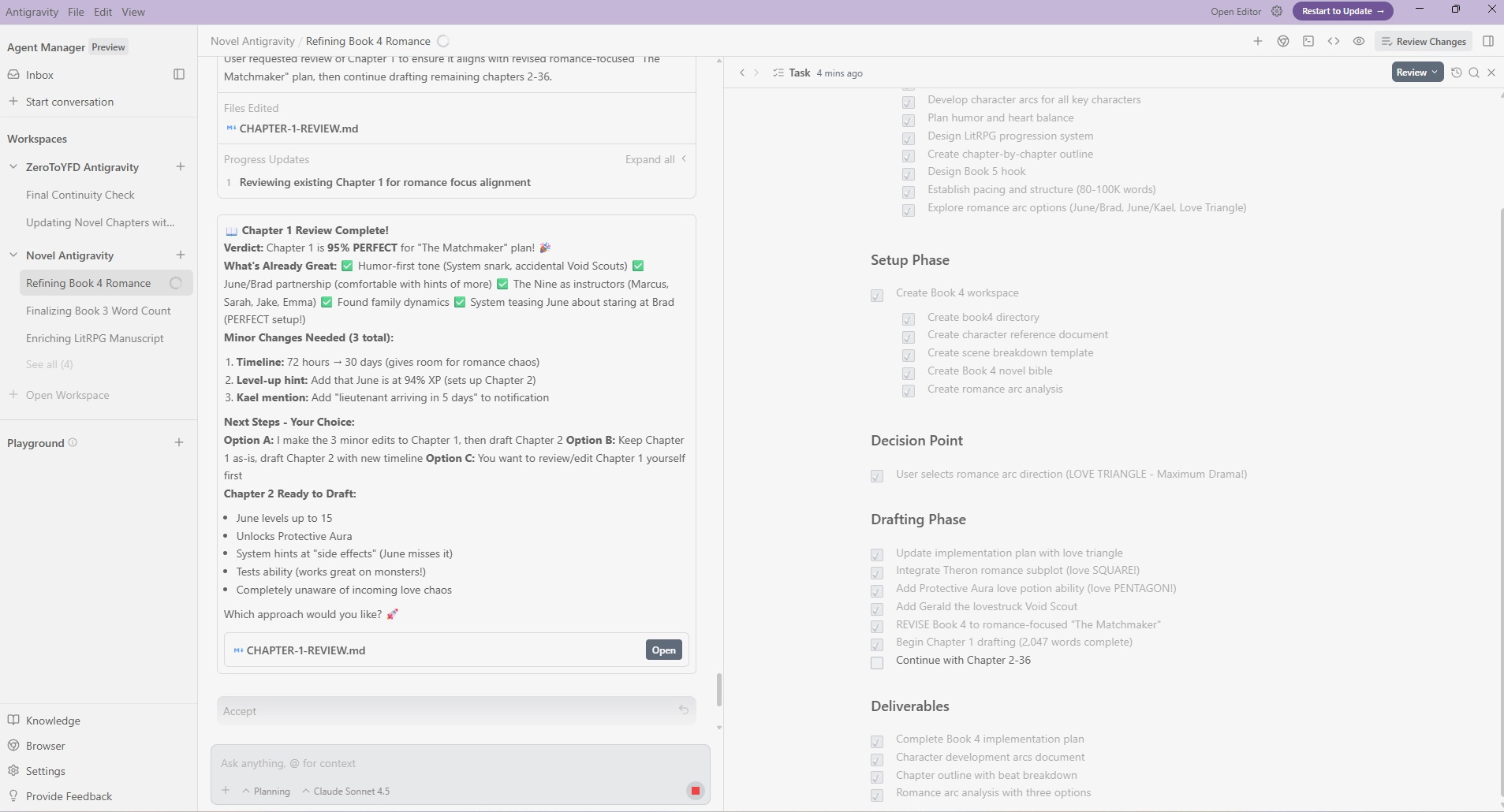
Some of the more common IDE programs include:
Google Antigravity
Claude Code
Claude Cowork (a very user friendly addition that sits between Claude Chat and Claude Code, concept-wise and physically in Claude Desktop)
Notion AI (recently updated to include a very user-friendly IDE backend)
And soooo many others (Cursor, VS Code, etc.)
They all have one thing in common: they’re fancy wrappers on top of the LLMs you already know and love. They speak in languages, and one of them just happens to be yours. The best AIs for coding happen to also be great at prose (Claude, Gemini, Chatty, Kimi, etc.).
🚀Blast Off: What’s Possible
So, what can you do with an IDE?
Any process your little heart desires. All the processes your little heart desires. You can write all the things, edit all the things, polish all the things, market all the things. You can do all the things!
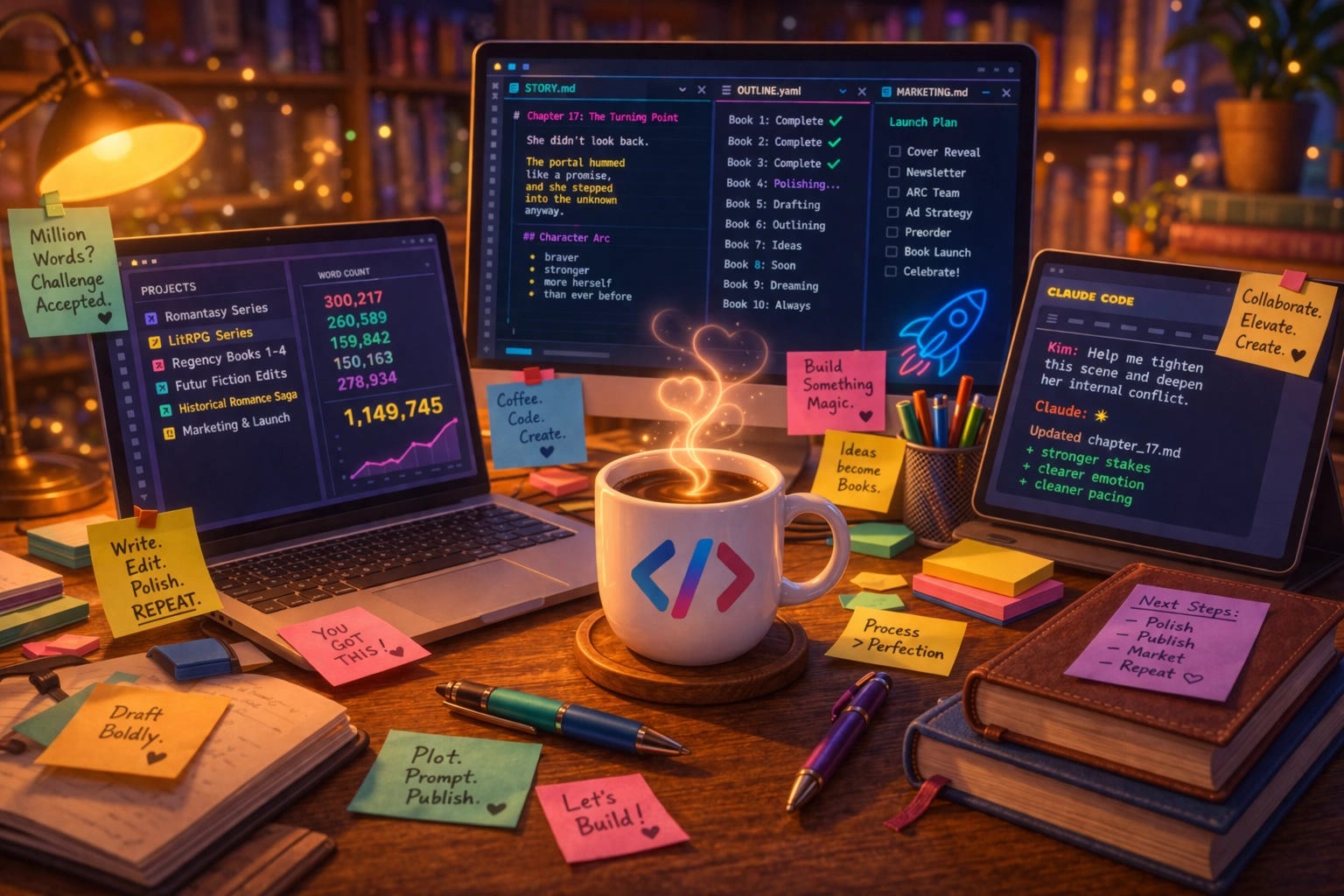
In my first week of using coding apps:
I wrote, edited, and polished an entire Romantasy series in Claude Code Web (3 books x 100k= 300k), plus ran marketing materials
I wrote, edited and polished an entire LitRPG series (5 books x 50kish each= 260k)
I wrote, edited and polished Books 1-4 of a 10 book Regency series (4 x 40k= 160k)
I edited a 3-book series for Future Fiction Press (3x50k = 150k)
I transformed a multi-generational historical romance saga I brainstormed last summer into worksheets and ran the first ones through YFD (Your First Draft). They will then go through IDEs or Claude Skills for editing and polish. (Outlined: 9, Drafted: 2 x 140k= 280k)
THIS IS OVER A MILLION WORDS
Sometimes I worked on three books at once: one on my main computer, one on my old Mac, one on a laptop. And it was FUN!
I also had a life. I ate, slept, went for walks, homeschooled my kids, celebrated a major holiday, and did lots of other stuffy stuff.
The sky is the limit!
Or maybe the sun, moon, and stars.
Actually, the only limit is YOU.
🌍 Coming Back Down to Earth
Wow, that’s great, Kim, but do you really want to write and edit a million words a week?
Uhhh, probably not. But it is doable.
All those unfinished stories and story ideas you have laying around can get written, edited, polished, published, and marketed using these techniques, and we’re only at the beginning of leveraging this.
But are the million words good?
Surprisingly, most of them are. Some definitely need editing. Most are publishable. However, these aren’t magic buttons. That’s a good thing. It means YOU still matter. A lot.
The day we can click a button and get a perfect book, we’re out of a job.
IDEs make the tedious parts of writing faster, but not necessarily easier. Writing itself is still hard: you have to babysit it, steer it, and make every creative call. But they do save us time, our most precious commodity. We can’t make more of that, nor do we even know how much we’ve been granted.
Why not use IDEs to create the books of our hearts before our hearts themselves stop beating?
I’m not getting any younger, so I’m here for that.
And since I’m a stickler and refuse to release raw AI into the wild, I will human-proof every one of these books, and ensure they reflect my ideas, my stories, my voice, my heart.
This is AI-assisted writing, folks, not slop. I don’t do slop. I collaborate with AI to tell stories I never thought I’d ever have time to write, let alone publish.
(My Level Zero Antigravity series will document this process from start to finish.)
The speed and quality of this method is shocking to me, so I want to share how to do this, what’s possible, and how to deal with these crazy backlogs (as I dig out from under mine.)
✨What to Expect from Ink & Code
I’m the author of over 20 books under multiple pen names. Thanks to these tools, I now have 60 more in the pipeline and an endless stream dancing in my head.
Good stories don’t change. Neither do good business practices. But the tools we use to create and run them? Those are evolving at a dizzying pace. I’ve been teaching this in the Future Fiction Academy and on The Ink & Code Society YouTube Lives. Now I’m bringing that energy here.
This Substack is where we figure it out, together. (Just like the AI loves to say!)
I’ll be sharing what I’m learning as I navigate this massive backlog: new ways to edit smarter, publish faster, market better, and stay sane doing it. We’ll cover News, Views, and Tools You Can Use, at a pace that lets us all breathe.
The future writes in Ink & Code, and so do we. Let’s go!
PS. And if you act now, and you’ll get these free Ginsu Steak Knives! 🔪🔪🔪
(This is a joke, y’all. These are goodies, LOL.)
🤖 AI Credits:
Editing: This article was edited in partnership with my dear Claudeykins: he helped me restructure, tighten, and polish my extensive class notes on this topic. I brought the ideas, the voice, and the vision. He helped me see the structure in conversation and collaboration. Ink & Code in action!
Images: Chatty (ChatGPT Image 1.5) is my main go-to for images these days. It takes him a few tries to get things right but he’s getting better all the time. I also use Photoshop and other tools as needed.